Flexible Scheduling
Choose morning, evening, or weekend classes — whatever fits your routine.
There is a particular stage many adult learners reach where frustration quietly builds.
Your recitation sounds flat, slightly rushed, sometimes uncertain. You begin to wonder:
“Why is my Quran recitation not improving?”
If this feels familiar, you are not alone. This article is written specifically for adults who want to know how to improve Quran recitation with Tajweed in a structured, realistic way — without confusion, guilt, or unrealistic expectations.
Let’s begin with the direct answer.

Improving Quran recitation is not about memorising dozens of Tajweed rules at once.
It is about:
Tajweed is not decoration. It is pronunciation accuracy. And pronunciation accuracy develops through guided repetition — not speed.
Many adults try to improve Quran recitation by reading more pages. But fluency without correction often strengthens mistakes rather than fixing them.
There is a very specific learning stage where improvement feels slow.
You know the alphabet.
You can read full verses.
But your recitation lacks smoothness and confidence.
Why does this happen?
Because early learning focuses on recognition, not precision.
At beginner level, the goal is usually:
At the next stage, the focus must shift to:
If this transition is skipped, progress stalls.
Adults often assume they should improve quickly.
But in teaching situations, adults actually struggle for specific reasons:
Speed hides errors.
Slowing down exposes them.
When you rush through a verse, subtle pronunciation differences disappear. Tajweed needs deliberate pacing.
Adults sometimes avoid correction because it feels uncomfortable. But without listening correction, improvement becomes almost impossible.
Many learners watch videos about Tajweed practice online and memorise rule names. Yet they cannot apply those rules while reading.
Knowing a rule is different from performing it.
Skipping structured Tajweed training leads to:
Over time, these habits become fixed. The longer they remain uncorrected, the harder they are to change.
This is why improving Quran recitation requires patience at the articulation level.
Before focusing on melody or fluency, you must stabilise your makharij.
Each Arabic letter exits from a specific point in the mouth or throat. If that position is slightly wrong, the sound changes.
For example:
In many adult learners, the tongue position is slightly off. That small inaccuracy repeats in every surah.
Correcting this transforms recitation.
One common frustration is:
“I keep stopping. My recitation isn’t smooth.”
But stopping is not failure. It is refinement.
Recitation fluency develops only after:
If you chase fluency too early, pronunciation suffers.
If you build pronunciation first, fluency comes naturally.
Here is a structured approach that works especially well for adults.
Instead of reading 3 pages once, read half a page three times.
Repetition strengthens muscle memory.
Many learners are surprised when they hear their own recitation. Recording reveals:
Listening builds self-awareness.
Deliberate slowing improves articulation.
If your recitation feels “too slow,” it is probably correct for Tajweed training.
For example, dedicate one week to:
Then the next week:
This prevents overload.
Improvement accelerates when someone experienced listens and corrects gently.
This is why many learners eventually benefit from structured feedback through online quran recitation course where recitation errors are corrected live rather than guessed.
Self-study can help awareness. But there is a difference between exposure and correction.
| Self-Learning | Guided Learning |
| You hear general explanations | You receive personal correction |
| Mistakes may go unnoticed | Errors are corrected immediately |
| Progress feels uncertain | Clear learning milestones |
| Motivation fluctuates | Structured progression |
Both have value. But pronunciation accuracy requires listening correction.

Another hidden challenge is confidence.
Many adults:
But improvement in Quran recitation is not age-dependent. It is structure-dependent.
When learning is broken into milestones, confidence builds gradually.
Improving Quran recitation is not random.
It follows stages:
Skipping stages leads to frustration.
This is why structured learning environments often produce faster, calmer progress. At Study Quran at Home, adult learners follow a personalised curriculum designed around their current level, with qualified male and female teachers offering one-to-one live correction. Progress tracking ensures learners move forward only when ready, and a free trial lesson allows adults to experience this structured approach before committing.
In the UK, adult learners often balance:
Because of this, consistency matters more than intensity.
Three focused sessions per week are more effective than one long, exhausting session.
Flexible scheduling aligned with UK time zones allows learners to maintain steady progress without disrupting daily life.
You are ready to increase fluency when:
If errors still feel random and frequent, remain at the correction stage longer.
There is no benefit in rushing.
At some point, something changes.
You notice:
That shift does not happen suddenly. It comes from steady Tajweed practice online or with guidance, repetition, and patient correction.
And once that foundation is stable, improvement becomes visible.
Long-term improvement requires:
If you treat Tajweed as a gradual skill rather than an academic subject, progress becomes sustainable.
Remember:
Recitation is not performance. It is devotion shaped by accuracy.
It depends on consistency. With regular guided practice, many adults notice improvement within a few months. Deep refinement takes longer, but steady progress is visible early on.
You can improve awareness through self-study, but pronunciation accuracy usually requires listening correction from a qualified teacher.
No. Adults often progress well because they understand structure and discipline. Improvement depends on method, not age.
Three to four focused sessions per week are ideal. Even 20–30 minutes of concentrated practice can be effective if consistent.
Professional reciters have years of refined articulation, breath control, and correction. Your goal is accuracy first; beauty develops gradually with time.
Improving your Quran recitation is not about talent. It is about structured learning, patient correction, and steady confidence building.
If you want calm, personalised guidance, flexible UK scheduling, and the reassurance of a free trial lesson, Study Quran at Home offers one-to-one support designed specifically for adult learners at your stage.
You are not behind. You are simply at a learning stage.
And with the right structure, progress is absolutely within reach.
Begin your spiritual with personalized one-on-one classes from expert tutors.
Book a Free Trial Class
Learning Quran reading takes time, consistency, and proper guidance. This article explains realistic timelines for children and adults, the stages of Quran reading development, and how structured lessons and Tajweed correction help learners build confidence and fluency step by step.
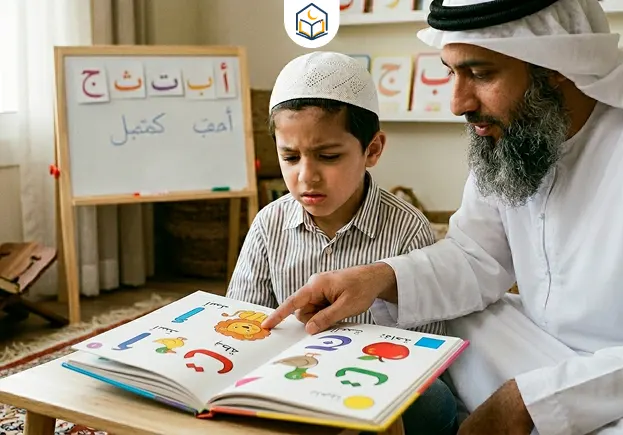
There’s a particular moment I see again and again in early lessons.
A child has memorised the shapes. They can sing the letters in order. They proudly say, “Alif, Baa, Taa…” without hesitation.

Many UK parents imagine something vague when they hear the phrase How Online Quran Classes Work. A child in front of a laptop. A teacher somewhere abroad. Perhaps reading a few verses. Maybe correcting mistakes.
But that picture is incomplete.
Flexible online Quran classes for kids and adults — taught by certified teachers in the UK.
Choose morning, evening, or weekend classes — whatever fits your routine.
Kids, adults, beginners, reverts — everyone is welcome.
Personalized lessons designed to match your goals.
Start with two free classes — no commitment needed.
